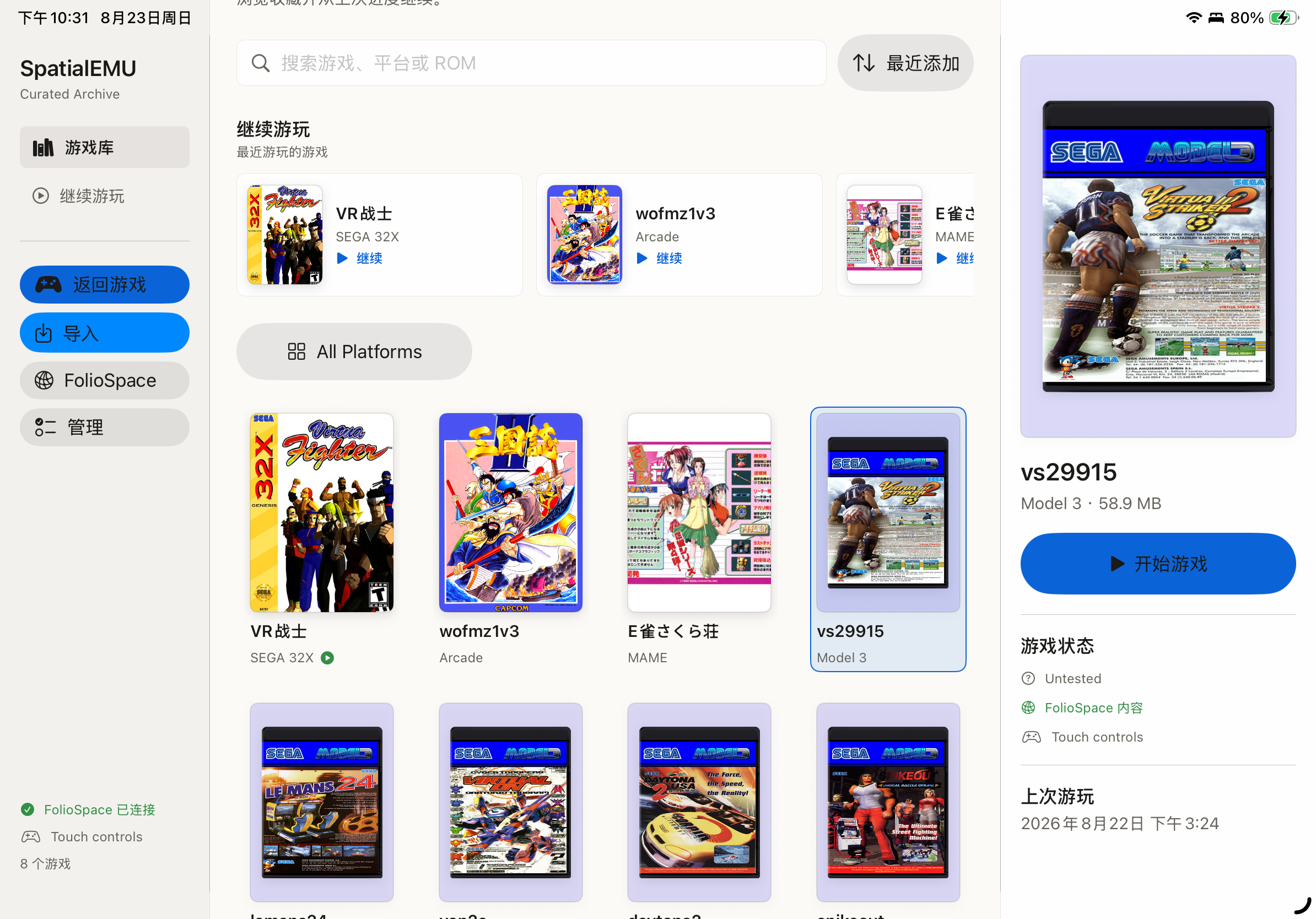
One controller profile that scales with the library
The 1.40 candidate adds universal controller mapping across global, system, and individual-game profiles. Players can remap buttons, choose axis sources, invert an axis, and tune dead zones and sensitivity. If no custom profile is enabled, the existing default behavior remains unchanged.
- Global, system-level, and per-game mappings
- Button and analog-axis reassignment
- Axis inversion, dead-zone, and sensitivity controls
- Capture, apply, cancel, reset, and reconnect behavior designed for safe editing
Native Model 3 cabinet rooms
Supported SEGA Model 3 titles can link as local cabinets instead of streaming video. Each device runs and renders its own local emulator while the LAN carries cabinet-link data. Create and Join flows, matching user-provided files, and title-specific support keep the feature honest.
- Player-plus-relay rooms for supported titles
- A physically accepted five-device Le Mans 24 data ring
- Daytona USA 2 three-to-eight-cabinet rooms clearly marked Experimental until the physical eight-device gate is complete
Vision Pro work that earns its own validation
On Apple Vision Pro, the preview focuses on spatial controls and more reliable handheld sessions. Virtual-On can use two PS VR2 Sense controllers as left and right Twin Sticks, while the 3DS runtime work covers CIA installation checks, window and stereo-session improvements, localization, and recovery. These are compatibility paths, not a promise that every title behaves alike.
- Explicit switching and connection status when Sense controllers and a standard gamepad are both present
- A validated install flow for compatible, user-provided 3DS CIA content
- Per-title NDS layout and touch-coordinate work on Vision Pro
A preview with clear boundaries
This is an update preview, not a claim that every candidate ships on the same day. Final availability depends on platform review, device testing, title compatibility, and release packaging. SpatialEMU does not include games, ROMs, BIOS files, firmware, keys, decryption, or third-party downloads; users provide files they have the right to use. Built-in recording is not part of the current public product claim.