What is new in 1.40
SpatialEMU 1.40 introduces local-network cabinet linking for selected Model 3 titles, including Daytona USA 2. Race with one friend through the classic two-cabinet setup, or invite up to seven friends into the new experimental cabinet ring. Each player runs the game locally on a compatible device while SpatialEMU carries the original cabinet-link data across the LAN.
Do you remember the row of linked cabinets?
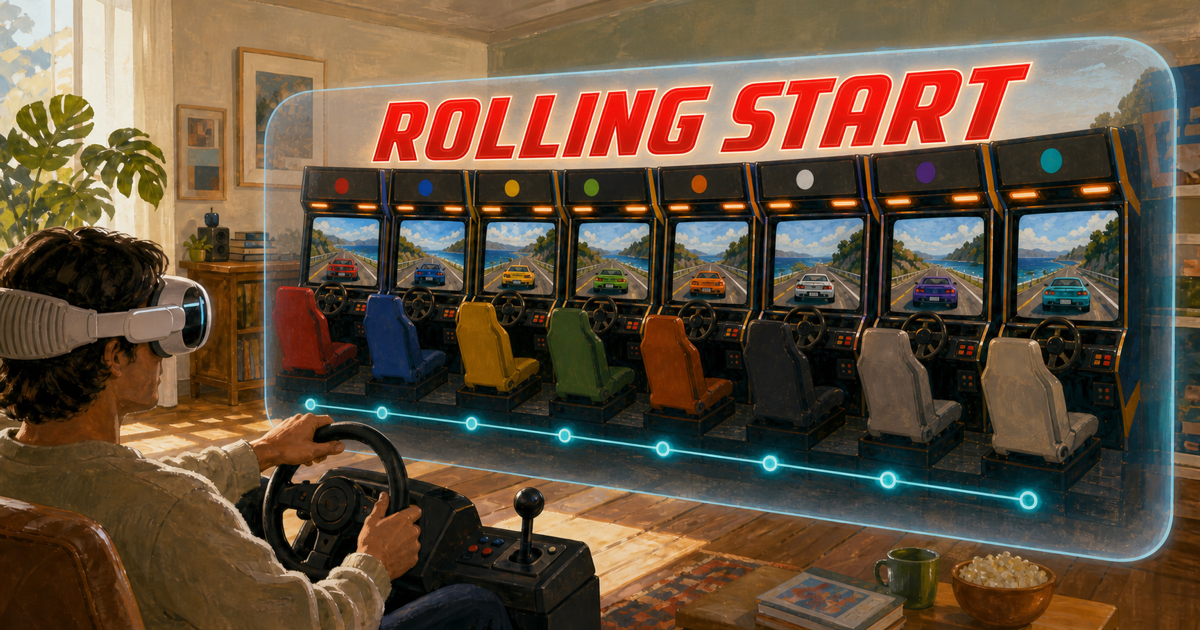
More than twenty years ago, multiplayer arcade racing was a physical experience before the race even began. You sat in a driver's seat with a steering wheel in front of you and a shifter at your side. Your friends occupied the cabinets next to yours. Everyone inserted a coin, joined the same grid, and waited for the start.
The opening banner filled the screen. Engines surrounded the room. The wheel pushed back through a corner, and for a few minutes the cabinet did a convincing job of making you believe that you were driving a real car.
That memory is what we wanted to recover, not by streaming one machine to several screens, but by reconnecting locally rendered cabinets.
From the arcade floor to Apple Vision Pro
On Apple Vision Pro, linked racing gains a wider field of view, a large spatial screen, and enveloping audio. The people racing beside you do not all need a Vision Pro. Friends using an Apple silicon Mac, iPhone, or iPad with a compatible SpatialEMU 1.40 build can join the same local-network session.
Every device runs and renders its own emulator. The network carries the cabinet-link traffic rather than a gameplay video stream, preserving the feeling that several independent arcade machines have been connected together.
Two ways to start a Daytona USA 2 race
Daytona USA 2 now presents two separate link paths before the ROM is launched:
The experimental eight-cabinet topology has passed automated testing with eight simultaneous instances. It has not yet completed an eight-device physical acceptance run, so the label is intentional and will remain until that test is complete.
- Classic two-cabinet link: the existing Create / Join flow for two players.
- 3-8 Cabinet Ring - Experimental: a separate room for three to eight playable cabinets.
Developer note: five devices are not eight
Our current device pool gives us five physical endpoints. We have completed long-duration multi-device validation on supported Model 3 network work, including Apple Vision Pro, iPad, iPhone, and Mac hardware. But five devices cannot honestly prove an eight-player race.
If you assemble and complete a real eight-device Daytona USA 2 session, we would like to hear from you. Please include the devices used, app versions, room size, session duration, and any disconnect or control issues. A successful result is useful; a reproducible failure is just as valuable.
Availability
SpatialEMU 1.40 build 44 for Apple silicon Mac is available now as a notarized DMG from the official SpatialEMU Downloads page. A full Mac build is therefore an immediate option when a friend needs another compatible endpoint.
SpatialEMU remains available for purchase from the App Store. One purchase covers iPhone, iPad, Apple Vision Pro, Apple TV, and Apple silicon Mac without a separate payment for each Apple platform. At the time of writing, the public App Store version is still 1.300 while the 1.40 Apple-platform update proceeds through review. iPhone and iPad availability may therefore follow later than the direct Mac release.
Before creating a room
All players must use:
SpatialEMU does not provide games, ROMs, BIOS files, firmware, keys, or third-party downloads. Every participant must provide files they have the right to use.
When the engines start again, we hope they bring back some of the happiness you remember.
Third-party product and game names are used only to identify compatibility and remain the property of their respective owners. SpatialEMU is an independent project and is not affiliated with or endorsed by SEGA.
- SpatialEMU 1.40 or later with compatible Model 3 runtimes;
- the same supported game and the exact same ROM data;
- devices connected to the same local network;
- the two-player or experimental multi-cabinet entry appropriate to the desired room size.